

Desk work is not a desk problem. It is a movement problem.
- James Hurst

- May 1
- 4 min read
If you have ever had a workstation assessment, you will have heard the same advice. Feet flat on the floor. Knees at right angles. Screen at eye level. Back straight. It is the standard HSE guidance, and it is not wrong. The problem is that it is not realistic either.

Nobody sits like that for eight hours. You might start the day in that position, but within an hour you are leaning forward, crossing your legs, or slumping into the back of your chair. That is not because you lack discipline. It is because your body is not designed to hold any single position for that long.
The advice treats the desk as the problem. In my experience, the real problem is the lack of movement.
What sitting actually does to your body
When you sit for long periods, your hip flexors shorten. The two muscles I work on most with desk workers are the psoas and the iliacus. These are part of your hip flexors, and they connect your lower spine to the top of your thigh bone. When they get short and tight, they pull on your lower back. That pull is often what creates that deep, persistent lower back ache people describe after a long day at a desk.
But it does not stop there. Your glutes switch off because they are not being used. Your upper back rounds forward. Your chest tightens. Your shoulders creep up toward your ears. Over weeks and months, your body learns to hold this shape. It becomes your default, and getting out of it takes more than just sitting up straight for a few minutes.
I see this pattern almost every week in clinic. The client comes in with back pain or shoulder tension, and when I assess them, the restriction is nearly always in the front of the body. Tight hip flexors, tight pecs, a shortened anterior chain. The back hurts because it is being pulled on, not because there is something wrong with it.
Sitting like a prawn
My clients love this one, but it is the most accurate way to describe what happens with people who do detailed screen work. If your job involves spreadsheets, financial analysis, editing, or anything that requires you to focus closely on a screen, you will naturally lean in. We all do it. When we read, we move toward the thing we are reading.
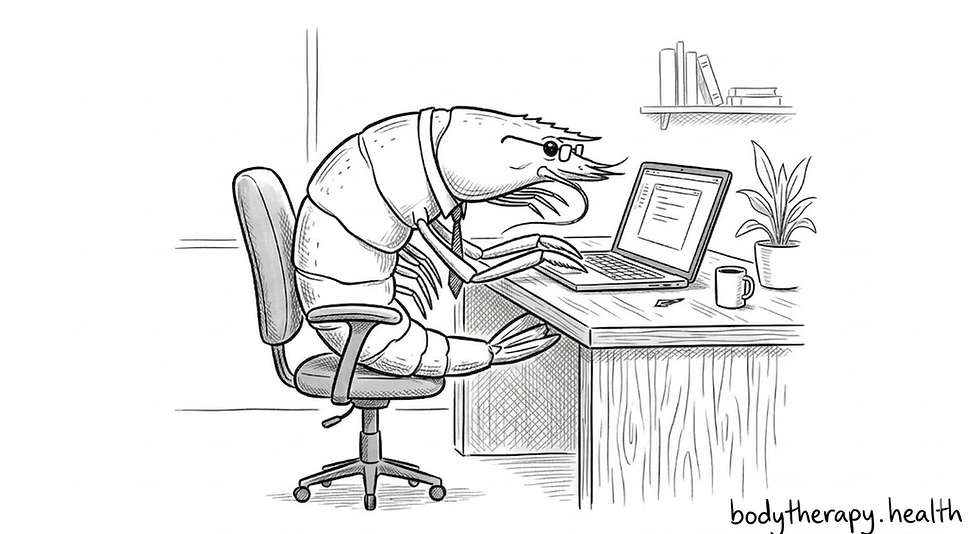
Over time this creates a posture that looks a bit like a prawn. Rounded upper back, head forward, shoulders curled in, hips flexed. It is not something you choose to do. It happens gradually because your body follows your attention.
One thing I tell these clients is to bring the screen uncomfortably close. It sounds counterintuitive, but when the screen is right in front of you, your body naturally sits back to create distance. You end up in a much better position without having to think about it. It is a simple trick, but it works far better than a Post-it note on your monitor reminding you to sit up straight.
Why the right-angles approach falls short
The HSE workstation guidance exists for good reason. It gives employers a baseline for setting up desks safely, and it reduces the risk of obvious problems like a screen that is too low or a chair that offers no support. I am not saying ignore it.
But the guidance assumes you will maintain that position throughout the day, and that is where it falls apart. The evidence increasingly points toward movement being more important than position. Your body does not need a perfect posture. It needs variety. It needs you to stand up, shift, stretch, walk to the kitchen, and change position regularly throughout the day.
A perfectly set up desk with someone frozen in the same position for four hours will still produce tension, stiffness, and pain. A less than perfect desk with someone who moves every 30 minutes will often feel better at the end of the day.
What actually helps
The most useful thing you can do is move more. That does not mean going to the gym at lunch, although that helps too. It means building small movements into your day. Standing up every 30 minutes. Walking while you take a phone call. Stretching your hip flexors at your desk. Rolling your shoulders back. These small interruptions stop your body from locking into one shape.
Strengthening matters too. When your glutes are weak from sitting all day, your lower back compensates. When your upper back muscles are underused, your shoulders round. Simple strengthening work, even five minutes a day, can change how your body holds itself during the hours you spend at a desk.
And when tension has built up to the point where stretching and moving are not enough, that is where treatment comes in. When I work with desk workers, I spend a lot of time on the psoas and iliacus because those deep hip flexors are almost always tight. Releasing them changes how the pelvis sits, which takes pressure off the lower back. It is one of the most noticeable changes clients feel after a session. They stand up and realise they are not being pulled forward any more.
It is not about the chair
You can spend hundreds on an ergonomic chair. You can set your desk up perfectly. But if you sit in the same position for hours without moving, your body will still tighten up and start to ache. The desk is not the problem. The stillness is.
If your back aches at the end of every working day and you have tried adjusting your setup without much change, it might be worth looking at what is happening in your body rather than what is happening at your desk. I also offer workstation assessments if you want help with both sides of that picture.
I am based in Sissinghurst, just outside Cranbrook, and I work with people from across the Weald of Kent. Book a massage


Comments